
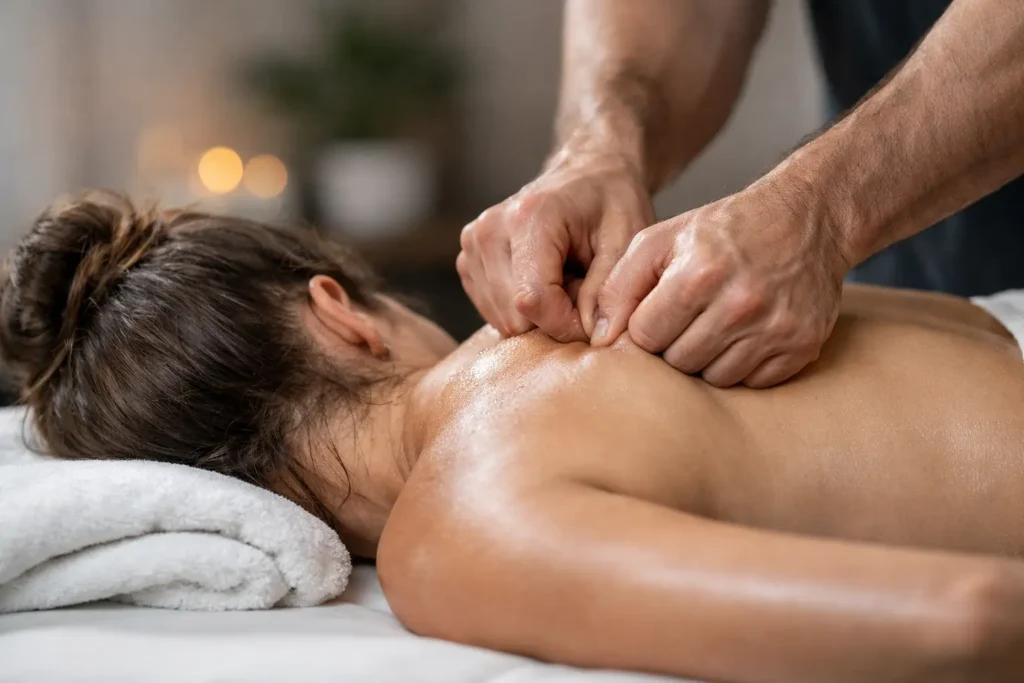
That hard, tender spot between your shoulder blades usually does not appear out of nowhere. It often builds quietly from hours at a desk, guarded posture during stress, repetitive movement, or the way your body compensates for pain somewhere else. Deep tissue massage for knots can help, but the best results come when the work is precise, patient, and matched to what your body is actually doing. If you’re in Portland and dealing with persistent muscle knots, this is a very common pattern I see.
Many people use the word knots to describe any area that feels tight, lumpy, or painful. In practice, those spots are often bands of tense muscle and fascia, areas of irritation around trigger points, or tissue that has stayed contracted for so long that movement feels restricted. The sensation is real, but the cause is not always simple. That is why effective treatment is rarely about pushing harder. It is about understanding why the area became overloaded in the first place.
What deep tissue massage for knots actually does
Deep tissue work is designed to reach layers of tension that lighter relaxation massage may not fully address. When muscle fibers stay shortened and connective tissue becomes less mobile, circulation can feel limited, movement can become stiff, and the body starts protecting the area. A skilled therapist uses slower, more focused pressure to encourage those tissues to soften and lengthen over time.
For knots in the neck, shoulders, and back, this can reduce the familiar pulling, burning, or ache that lingers through the day. It may also improve range of motion, make it easier to sit or stand comfortably, and decrease pain that refers into the head, arms, or low back. Even so, a knot is often part of a larger pattern. Tight shoulders may be linked to chest tension, jaw clenching, rib restriction, or fatigue in the mid-back. Low back tightness may reflect overworked spinal muscles that are compensating for limited hip mobility.
This is where individualized bodywork matters. Treating the painful spot alone can bring temporary relief, but longer-lasting change often comes from addressing the surrounding structures and the habits that keep re-creating the same strain.
Not all pressure is therapeutic
There is a common belief that deep tissue only works if it hurts. That idea keeps many people from getting help, and it also leads some to tolerate more intensity than their body can use well. Strong pressure can be helpful, but only when the tissue is ready for it and the nervous system is not bracing against it.
If pressure is too aggressive, muscles may tighten defensively rather than release. You might leave feeling sore without actually feeling freer. Productive deep tissue work often feels intense but steady, with a sense that the tissue is responding rather than fighting back. Communication during the session is part of the treatment, not an interruption to it.
A thoughtful therapist pays attention to breathing, tissue resistance, posture, and your history of pain. Some knots respond best to direct sustained work. Others improve more with gradual warming, broad compression, stretching, or work in a related area. There is rarely one correct formula for every body.
Why knots keep coming back
When the same spot tightens again and again, the body is usually telling a larger story. For Portland clients who spend long days commuting, working on laptops, carrying children, training hard, or holding stress in the shoulders, knots are often a symptom of accumulated load.
Sometimes the issue is mechanical. Rounded shoulders, limited thoracic mobility, or repetitive overhead work can keep specific muscles doing too much. Sometimes it is emotional and physiological. Stress can change breathing patterns, increase clenching, and leave the neck and upper back in a constant low-grade state of guarding. Often it is both.
This is why deep tissue massage for knots works best as part of a broader therapeutic approach. The goal is not only to flatten a painful spot for a day or two. It is to help the body shift out of a pattern of overprotection so relief can last longer.
What a personalized session should feel like
A good session begins before any hands-on work starts. Your therapist should want to know where you feel pain, when it started, what makes it worse, and how it affects daily life. A knot in the right shoulder means something different for a graphic designer than it does for a parent lifting a toddler or a runner with a restricted arm swing.
From there, the work should be tailored. One person may need focused treatment around the upper trapezius, levator scapulae, and rotator cuff. Another may need attention to the chest, diaphragm, scalp, and mid-back to reduce the tension pattern feeding the shoulders. If the low back feels knotted, the hips and glutes may need as much attention as the lumbar muscles themselves.
At Senju Holistic Healing, this kind of one-on-one care is central to the therapeutic process. Personalized bodywork in a calm, private setting allows space to work with both the immediate pain and the deeper pattern behind it.
Deep tissue massage for knots in common trouble areas
Knots in the neck and shoulders are often tied to stress, screen time, and forward head posture. These areas can refer pain into the base of the skull and trigger headaches or a heavy, fatigued feeling through the upper back. Treatment usually benefits from a combination of direct work and support for better tissue mobility around the chest and shoulder girdle.
Between the shoulder blades, knots can feel stubborn because the area is influenced by posture, breathing, and prolonged sitting. The muscles there often work overtime to stabilize the upper body. Deep tissue can help reduce the dense, aching tension, but the surrounding ribs, shoulders, and neck often need treatment too.
In the low back, knots may be linked to lifting, standing for long periods, weak glute support, or guarding from old injuries. This area can be sensitive, so depth has to be earned. Often the most effective sessions include slower work through the hips, sacral area, and posterior chain rather than forcing pressure directly into already irritated tissue.
What to expect after treatment
After a well-paced session, many people notice easier movement, less pulling in the treated area, and a quieter nervous system overall. Some soreness is normal, especially if the tissue has been restricted for a long time, but you should still feel like your body has more room rather than less.
Hydration, light movement, and rest can help your system integrate the work. It is also helpful to notice what changes over the next day or two. Does turning your head feel easier? Are you sitting with less strain? Is the knot less intense by evening, when it is usually at its worst? These small shifts often show that the tissue and nervous system are responding.
For long-standing patterns, one session may provide meaningful relief without fully resolving the problem. That is not failure. Chronic tension usually develops over months or years, and it often responds best to consistent care rather than a single intense treatment.
When deep tissue is helpful, and when it depends
Deep tissue massage can be especially valuable when knots are related to chronic muscle tension, repetitive strain, postural stress, or overuse. It can also support recovery when stress has settled into the body and created a constant sense of tightness.
But there are times to proceed carefully. If an area is acutely inflamed, recently injured, bruised, or causing sharp nerve symptoms, the approach may need to be modified. Some clients also do better with a blend of deep tissue, Swedish techniques, and modalities such as Shiatsu rather than deep pressure alone. The body does not always need more force. Sometimes it needs a more skillful conversation.
That is especially true for people who carry both physical and emotional tension. When the nervous system has been running on alert, slower, grounded work can create deeper release than intensity by itself. Lasting relief often comes from respecting both the structure of the body and the state of the person living in it.
The real goal is not just release, but change
There is real relief in feeling a knot soften under skilled hands. But the deeper goal is to help your body stop relying on that tension as a default strategy. When treatment is personalized, calm, and informed by how your whole system works, deep tissue massage becomes more than temporary muscle relief. It becomes a way to restore ease, movement, and a steadier relationship with your own body.
If a knot has been asking for your attention for weeks or months, that discomfort may be less of an isolated problem and more of an invitation to listen more closely. With the right care, even stubborn tension can begin to shift.
If you’re dealing with ongoing muscle knots in Portland, a personalized session may help address the underlying patterns, not just the symptoms.
You can book a session here.