
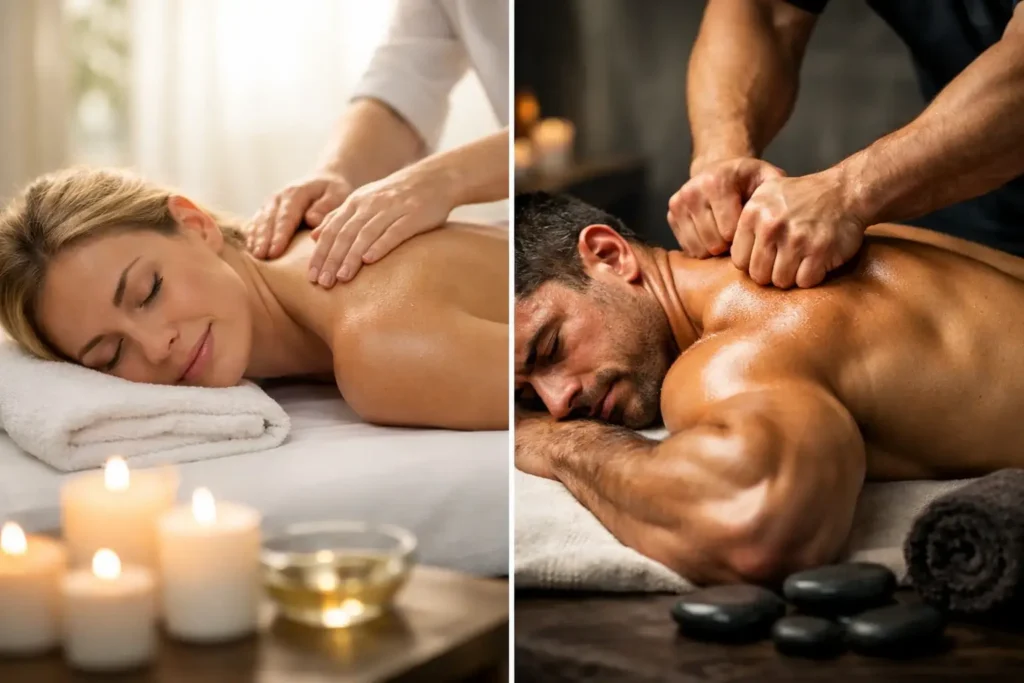
You wake up with a stiff neck, tight shoulders, or that familiar ache between your shoulder blades, and the same question comes up: should you book a relaxing massage or a more targeted one? When people compare swedish vs deep tissue massage, they are usually trying to answer something very practical – what will actually help my body feel better? If you’re in Portland and trying to decide which type of massage is right for your body, this is a very common question.
The answer depends on more than pressure alone. Swedish and deep tissue massage can both support relief, but they do so in different ways, with different goals, and for different kinds of tension. If you are choosing between them, it helps to understand not just how they feel during the session, but how they work in the body afterward.
Swedish vs deep tissue massage: the core difference
At the simplest level, Swedish massage is designed to calm the nervous system, improve circulation, and ease general muscular tension. Deep tissue massage is more focused on specific areas of chronic tightness, restricted movement, and stubborn discomfort in deeper layers of muscle and connective tissue.
That does not mean Swedish is only for relaxation, or that deep tissue is always intense. This is where many people get misled. Swedish massage can be highly therapeutic, especially for stress-related tension, fatigue, and full-body tightness. Deep tissue can also be measured and skillful rather than forceful. The real distinction is usually intention.
In a Swedish session, the therapist often uses long flowing strokes, kneading, gentle stretching, and rhythmic movements to help the whole body settle. In a deep tissue session, the work tends to be slower, more focused, and more deliberate, especially around areas like the neck, shoulders, low back, and hips.
What Swedish massage is best for
Swedish massage is often the better starting point for people whose body feels overworked, tense, or depleted rather than sharply restricted. If stress has been building for weeks, your sleep has been poor, and your muscles feel generally tight without one specific problem area, Swedish massage can be deeply restorative.
Its benefits are not only emotional, though that matters. When the body shifts out of a guarded, stressed state, muscles often release more naturally. Many people carry tension because their nervous system rarely gets a chance to soften. Swedish massage supports that shift.
This approach can be especially helpful if you are dealing with mild to moderate muscle tightness, stress headaches, desk-related fatigue, or a sense that your whole body needs to reset. It is also a good fit for first-time massage clients, people who are sensitive to pressure, or anyone who wants treatment that feels calming rather than corrective.
For some clients, Swedish massage becomes part of ongoing wellness care. It helps them stay ahead of pain instead of waiting until tension becomes severe.
What deep tissue massage is best for
Deep tissue massage is generally chosen when there is a clearer pattern of chronic muscular strain. Maybe your shoulders always feel glued upward. Maybe your lower back tightens after sitting all day. Maybe your range of motion has narrowed, and stretching alone is not changing much.
In those cases, deeper and more targeted work can help address tissue that has been holding tension for a long time. Deep tissue techniques often focus on muscle adhesions, postural strain, repetitive-use patterns, and compensations that develop when one area of the body has been overworking for another.
This type of work is often useful for chronic neck and shoulder pain, upper back tension from computer work, low back tightness, and areas that feel dense, restricted, or persistently sore. It can also support recovery from physical strain, as long as the timing and pressure are appropriate.
Still, deeper pressure is not automatically better. If the body braces against the work, the session can become less productive. Effective deep tissue massage should feel purposeful and tolerable, not like you are enduring something. There can be intensity, but there should also be communication, precision, and a sense that the therapist is working with your body rather than against it.
Pressure is only part of the story
One of the biggest misunderstandings in swedish vs deep tissue massage is the idea that the choice comes down to light pressure versus hard pressure. In practice, it is more nuanced than that.
A skilled Swedish massage can use moderate pressure and still create meaningful relief. A skilled deep tissue massage may not feel uniformly deep at all. Often, the therapist adjusts pressure based on the area being treated, the condition of the tissue, your stress level, and how your body responds in real time.
If your nervous system is already overloaded, very aggressive work may leave you more tense, not less. If your muscles have been guarding for months, they may need a gradual approach before deeper techniques are useful. On the other hand, if there is a long-standing pattern of restriction and your body responds well to focused pressure, deeper work may bring more lasting change.
This is why individualized care matters so much. The best massage is not the one with the most pressure. It is the one that matches your needs.
How each massage feels during and after
Swedish massage usually feels flowing, grounding, and spacious. Many people notice their breathing deepen during the session. Afterward, they often feel lighter, calmer, and less compressed in the body. There may be immediate relief from general tightness, along with a sense of mental quiet.
Deep tissue massage tends to feel more specific. The therapist may spend more time on fewer areas, using slower strokes and sustained pressure. During the session, you may notice tenderness in spots that have been holding tension for a long time. Afterward, you may feel looser and more mobile, though some people also experience mild soreness for a day or so.
Neither response is inherently better. If you leave feeling restored and your pain eases, Swedish may have been exactly right. If you leave with improved movement and less concentrated discomfort in a problem area, deep tissue may have been the better fit.
Swedish vs deep tissue massage for neck, shoulder, and back pain
For neck, shoulder, and back issues, the right choice often depends on the source of the tension. If your pain is tied closely to stress, poor sleep, emotional overload, or general muscular fatigue, Swedish massage may help more than you expect. The body sometimes needs safety and down-regulation before it can let go.
If your discomfort is more structural or repetitive, such as rounded shoulders from desk work, low back tightness from long commutes, or chronic shoulder restriction from overuse, deep tissue massage may be more effective. It can target the denser areas that keep pulling your posture and movement off balance.
Sometimes the most effective treatment is not purely one or the other. A therapist may begin with Swedish-based techniques to relax the body and warm the tissue, then apply focused deep tissue work where needed. That blended approach is often ideal for clients who want both relief and results.
This is especially true for people who have lived with pain for a while. Their body may need both nervous system support and precise therapeutic work.
Which one should you choose?
If you want full-body relaxation, stress relief, and gentle but meaningful tension release, start with Swedish massage. If you have a specific area of chronic pain, limited mobility, or deeper muscular tightness that has not improved with lighter work, deep tissue may be more appropriate.
If you are unsure, think about what you want most from the session. Do you want to feel calmer and reset? Do you want help with one stubborn issue? Do you tend to feel better with gentler care, or do you usually need more focused pressure before a muscle releases?
It is also worth considering your current stress level. A body under heavy stress often benefits from a treatment that is therapeutic without being overwhelming. More intensity is not always the shortest path to relief.
For many clients, the best results come from working with a therapist who can assess your symptoms, listen to your goals, and adjust the session accordingly. At a practice like Senju Holistic Healing, that personalized approach matters because pain is rarely one-dimensional. The muscles, posture, stress response, and daily habits all influence what kind of bodywork will help most.
A good massage should meet you where you are. Some days your body needs focused corrective work. Other days it needs quiet, circulation, and room to recover. Knowing the difference is part of receiving care that truly supports healing.
If you are deciding between Swedish and deep tissue, start by paying attention to what your body has been asking for lately, not just what sounds stronger or more effective on paper. Relief often begins when the treatment matches the person, not the label.
If you’re deciding between Swedish and deep tissue massage in Portland, a personalized session can help match the right approach to your body, your tension patterns, and your goals.
You can book a session here.