
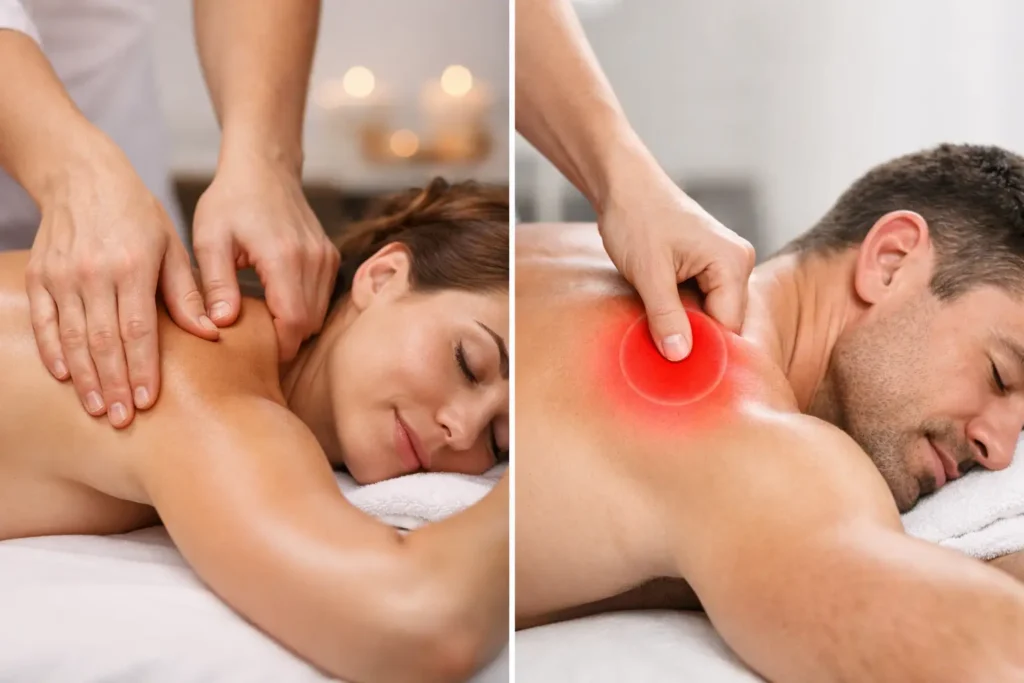
A tight band across the tops of your shoulders, a stubborn spot beside the shoulder blade, or a low back that never quite settles can make one question feel urgent: deep tissue or trigger point work? The best answer is rarely a simple choice between two separate styles. It depends on where you feel discomfort, how your body responds to pressure, what may be contributing to the tension, and what you want to feel different after the session.
For many people, the most useful therapeutic massage combines both approaches in measured, thoughtful ways. Deep tissue techniques can address broader layers of tightness, while trigger point work can focus attention on particularly sensitive or recurring areas. Neither approach needs to mean forcing the body through intense pressure.
What Deep Tissue Massage Is Designed to Address
Deep tissue massage refers to work that is intended to reach deeper layers of muscle and connective tissue. It is often useful when tension feels broad, dense, or longstanding – such as the heavy feeling through the upper back after months of desk work, training, driving, or stress-related bracing.
The word “deep” can be misleading. It does not automatically mean painful or aggressive. Effective deep tissue work may use slow pressure, gradual warming of the area, sustained contact, and techniques that follow the direction of the muscle. A skilled therapist adjusts pressure based on the area being worked and your response in the moment.
For example, someone with persistent neck and shoulder tightness may have tension extending from the upper back toward the base of the skull. Working only on the most tender spot may not be the most comfortable or productive starting point. Broader work through the shoulders, upper back, chest, and surrounding tissues may help the area feel less guarded before more focused techniques are used.
Deep tissue work is often a good fit when you describe your discomfort as widespread stiffness, heaviness, limited ease of movement, or a general sense that your muscles are always “on.” It can also be appropriate when tension has built gradually rather than appearing as one distinct knot.
How Trigger Point Work Feels Different
Trigger point work is more targeted. A trigger point is a sensitive, tight area within a muscle that may feel like a small knot, tender band, or concentrated point of discomfort. Pressing it can sometimes produce a familiar sensation in the same area or a referral pattern elsewhere nearby.
A common example is a sensitive point in the upper shoulder that contributes to tension traveling up toward the neck or head. Another is a tight area around the hip or low back that feels especially noticeable after standing, sitting, or walking. These patterns vary widely from person to person, which is why communication matters more than following a fixed map.
During trigger point work, pressure is usually applied with care and held briefly or worked gradually while you breathe and give feedback. The goal is not to endure as much intensity as possible. Pressure should feel purposeful and manageable, not sharp, alarming, or like you need to hold your breath to get through it.
Because it is specific, trigger point work can be helpful when you can clearly point to a recurring trouble spot. Still, a focused point is often part of a larger tension pattern. Treating it in isolation may offer only short-lived comfort if the surrounding muscles are overloaded, fatigued, or compensating for how you sit, work, train, or recover.
Deep Tissue or Trigger Point: The Better Choice Depends
If you are deciding between deep tissue or trigger point massage, think less about which technique sounds stronger and more about the pattern you are experiencing. Broad, persistent tightness may respond well to slower work across a larger area. A distinct knot that keeps returning may benefit from focused attention, often combined with work on the tissues around it.
Many sessions include both. A therapist may begin with slower, broader techniques to help the body settle and assess where the tension is most pronounced. Trigger point work may then be introduced in small doses, followed by additional massage to the surrounding area. Depending on your needs, shiatsu-informed pressure, gentle movement, therapeutic cupping, craniosacral techniques, or other supportive methods may also be incorporated. These are not add-ons for their own sake. They are selected when they suit your comfort, sensitivity, and goals.
There are times when less intensity is the better approach. If an area is highly sensitive, you are feeling run down, you have not received bodywork recently, or stress has left you feeling physically guarded, heavy pressure may make it harder to relax into the work. In those cases, a gradual session can still feel therapeutic without leaving you overwhelmed afterward.
What Productive Pressure Should Feel Like
People often assume that a massage only “works” if it hurts. That belief can lead to sessions that feel like something to survive rather than care your body can use. While therapeutic work may involve strong sensation, more pressure is not always better pressure.
Productive pressure usually feels clear and tolerable. You may notice tenderness, warmth, a release of guarding, or a gradual softening in the area. You should be able to breathe normally and tell your therapist what you feel. If you tense against the pressure, experience sharp or burning pain, feel numbness or tingling, or find yourself bracing, speak up right away.
A personalized session is a conversation. Your feedback helps guide the pace, depth, and technique. It also helps distinguish a momentary sensitive area from pressure that is simply too much for your body that day.
Why Recurring Knots Need a Bigger View
Recurring knots are frustrating because they can feel like the same problem returning on repeat. Yet the sore spot is not always the whole story. A tight area between the shoulder blades, for instance, may be influenced by long hours at a computer, a forward-reaching posture, shallow stress breathing, carrying a bag on one side, or a workout routine that does not leave enough room for recovery.
Massage cannot remove every source of daily strain, but it can offer a practical reset and a clearer sense of where your body is holding tension. The most sustainable results often come from pairing bodywork with realistic adjustments outside the session: changing positions more often, taking brief movement breaks, varying repetitive tasks, supporting recovery after training, and noticing when stress is showing up physically.
You do not need a perfect routine for these changes to help. Small, repeatable choices are often more useful than an ambitious plan that disappears after a week.
Preparing for a Therapeutic Massage Session
Before your appointment, it helps to notice what makes your discomfort better or worse. Consider whether the tension is most noticeable in the morning, after work, during exercise, or after sitting for a long time. Think about whether you want help with a specific area, broader stress-related tightness, or improved comfort moving through the day.
During the intake, share relevant information about recent injuries, surgeries, health changes, medications, skin sensitivity, or conditions that may affect massage. This helps the therapist choose appropriate techniques and avoid areas or pressure that may not be suitable. If you have severe, sudden, unexplained, or worsening symptoms, or symptoms such as weakness, numbness, fever, or loss of coordination, seek guidance from a qualified medical professional before scheduling bodywork.
At Senju Holistic Healing in SW Portland, sessions are one-on-one and adapted to the person on the table rather than built around a predetermined sequence. Whether the work involves deeper broad pressure, careful trigger point techniques, or a gentler approach, the aim is practical: help you leave with greater ease, clearer awareness of your tension patterns, and a plan for caring for your body between visits.
The right choice is not necessarily deep tissue or trigger point. It is the approach that respects what your body is asking for now, while supporting more comfortable movement and steadier relief over time.