
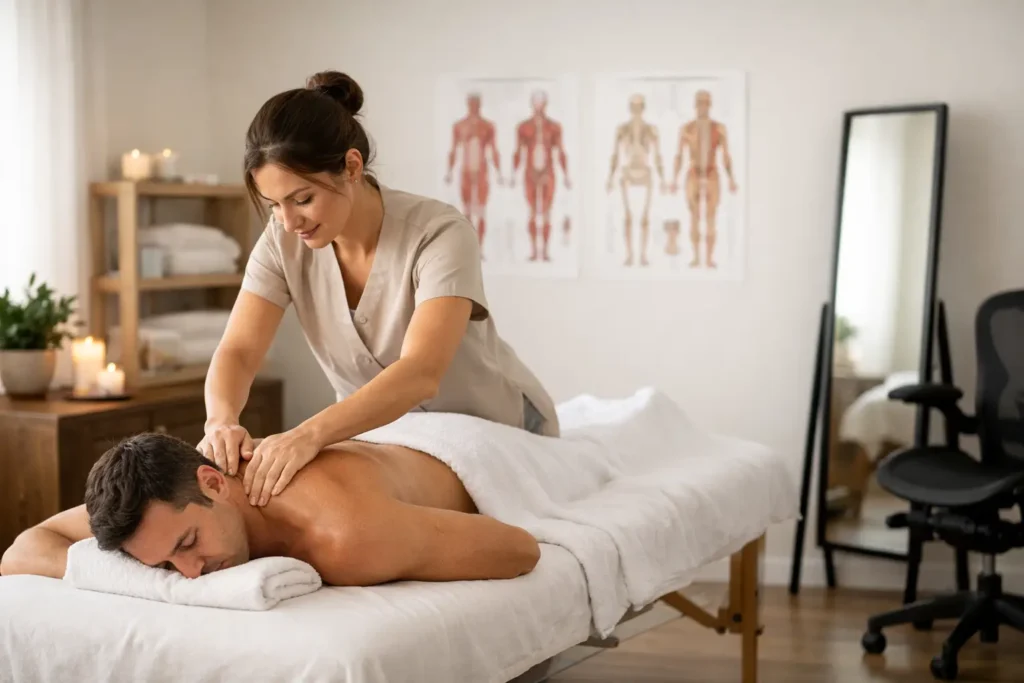
A stiff neck after a long workday is rarely caused by one “bad” sitting position. More often, it is the result of hours spent leaning toward a screen, holding a phone, driving, carrying a child, training hard, or working through stress without enough movement. The body adapts to what it does repeatedly. Over time, that adaptation can feel like persistent pulling across the shoulders, a tight upper back, limited neck rotation, or knots that return as soon as the week gets busy. Understanding how massage helps posture tension begins with seeing posture as a pattern of loading, movement, and muscle response rather than a simple matter of sitting perfectly straight.
Posture tension is more than slouching
Posture is not a fixed pose to hold all day. Healthy posture includes the ability to shift, reach, turn, breathe, and change positions without excessive strain. Even an upright, well-arranged desk setup can become uncomfortable when the body remains there for too long.
When certain muscles work continuously to support the head, shoulders, arms, or low back, they may become guarded and sensitive. The upper trapezius and muscles around the shoulder blades are common examples for desk workers, while the chest, hips, forearms, and jaw can also contribute to a broader pattern of tension. Stress often adds another layer. Many people unconsciously lift their shoulders, clench their jaw, or brace through the abdomen when they are under pressure.
Massage cannot make a person permanently immune to the demands of work or daily life. What it can do is help reduce the feeling of overwork in tissues that have been carrying too much for too long, while making comfortable movement easier to access again.
How massage helps posture tension in practical ways
Therapeutic massage supports posture-related discomfort through careful hands-on work that responds to the individual rather than following a fixed routine. A session may include slower deep tissue techniques, focused trigger point work, shiatsu-informed pressure, gentle movement, or other approaches based on the areas involved and the client’s comfort level.
It helps soften protective muscle holding
Muscles often tighten for a reason. They may be responding to repetitive activity, fatigue, stress, or a lack of variety in movement. This does not necessarily mean the muscles are weak, damaged, or “out of place.” It may simply mean they have been working hard and have not had a chance to settle.
Thoughtful pressure and pacing can help decrease the sense of guarding in overactive areas. For someone who feels their shoulders creeping upward all day, this might mean working with the neck, upper back, chest, and shoulder muscles rather than pressing intensely on one painful spot. When the surrounding tissues are addressed, the body may feel less compelled to hold the same tension pattern.
Deep pressure is not always better. A sensitive, stressed, or highly guarded body may respond more comfortably to gradual work. The right amount of pressure is the amount that feels therapeutic and manageable, not something to endure.
It can improve comfort during everyday movement
Posture tension often becomes most noticeable when moving: turning to check a blind spot while driving, reaching overhead, looking down at a laptop, or getting up after sitting. Massage may support a more comfortable range of motion by addressing tight or sensitive tissue around the areas that feel restricted.
For example, neck tension is not always only about the neck. Stiffness through the chest, shoulders, upper back, and even the forearms can affect how freely the head and arms move. A personalized session considers these relationships. Instead of treating the body as separate parts, the work can follow the tension pattern that is actually present.
The result is not necessarily dramatic flexibility. Often, the meaningful change is simpler: turning the head feels easier, the shoulders rest lower, or sitting through a meeting feels less demanding.
It brings attention to recurring patterns
Many people know where they hurt but have not had the opportunity to notice when the tension builds or what seems to aggravate it. A therapeutic massage session creates a quiet space to pay attention to those patterns.
During hands-on work, clients may recognize that one shoulder consistently feels more loaded, that their ribs feel restricted when breathing deeply, or that their low back tightens after a particular workout or commute. This awareness can be useful because it turns a vague problem into something more practical to respond to.
Massage therapists do not need to diagnose the cause of every ache to offer meaningful care. Careful listening, informed observation, and clear communication can help guide the session while respecting the limits of massage therapy.
Why one area can affect another
The body does not organize tension according to office-chair diagrams. Someone with headaches or neck tightness may also have a chest that feels shortened from screen work, shoulders that do not move freely, or hands and forearms that stay active from keyboard and phone use. Someone with a sore low back may be dealing with long periods of standing, hip stiffness, training fatigue, or general stress-related bracing.
That is why a focused massage session may include areas beyond the place that hurts most. Working around the shoulder blades, chest, neck, and arms can be appropriate for upper-body posture strain. For lower-body patterns, the approach may include the hips, glutes, thighs, and low back when those areas are relevant.
Supporting techniques such as therapeutic cupping, craniosacral work, or gentle lymphatic drainage methods may be useful in some sessions, but they are not automatically needed. At Senju Holistic Healing, the approach is adapted to the person’s sensitivity, goals, activity level, and current tension pattern. The method should serve the client, not the other way around.
Massage works best alongside movement and work habits
A massage can create relief, but the body still returns to the routines that shape its day. That is not a failure of the session. It is simply why posture care is most effective when it includes small, realistic changes between appointments.
For a desk worker, that may mean standing up briefly between tasks, placing the screen at a more comfortable height, changing the position of the keyboard or chair, or taking a few unhurried shoulder and neck movements during the day. For an active person, it may mean allowing recovery time after training rather than waiting for tightness to become severe. For a busy parent, it may mean noticing how one-sided carrying, feeding, or lifting affects the shoulders and back.
The goal is not to create a perfect routine that adds more pressure to an already full schedule. A few consistent adjustments are often more useful than an ambitious plan that disappears after three days. Massage can make those changes easier to feel and maintain because the body is less distracted by constant discomfort.
What to expect from a personalized session
For posture-related tension, a helpful session usually begins with a conversation about where discomfort appears, how long it has been present, what activities affect it, and what kind of pressure feels appropriate. A client who is sensitive to deep work needs a different approach than someone whose tissues respond well to firmer, slower pressure.
The work may focus on one main region, such as the neck and shoulders, or include connected areas that are contributing to the overall pattern. Communication remains part of the session. Pressure can be adjusted, and the plan can change if an area feels more reactive than expected.
Some people feel looser and calmer immediately afterward. Others notice changes over the next day or two, particularly when long-standing tightness has been addressed. Mild tenderness can happen after deeper work, especially if the muscles were already sensitive. Hydration, normal movement, and avoiding an unusually intense workout right after a session may help the body settle comfortably.
When massage is not the only next step
Massage is well suited to many common experiences of muscular tightness and posture strain, but persistent or unusual symptoms deserve appropriate medical attention. New severe pain, numbness, weakness, unexplained swelling, pain after a significant injury, or symptoms that are getting worse should be evaluated by a qualified healthcare professional.
For everyday tension, though, therapeutic massage can be a steady part of body care. It offers focused time to reduce accumulated strain, reconnect with easier movement, and respond to discomfort before it becomes the background noise of every day.
Your body does not need to hold one ideal posture. It needs regular opportunities to move, recover, and feel supported. A personalized massage session can be one calm, practical way to give it that opportunity.