
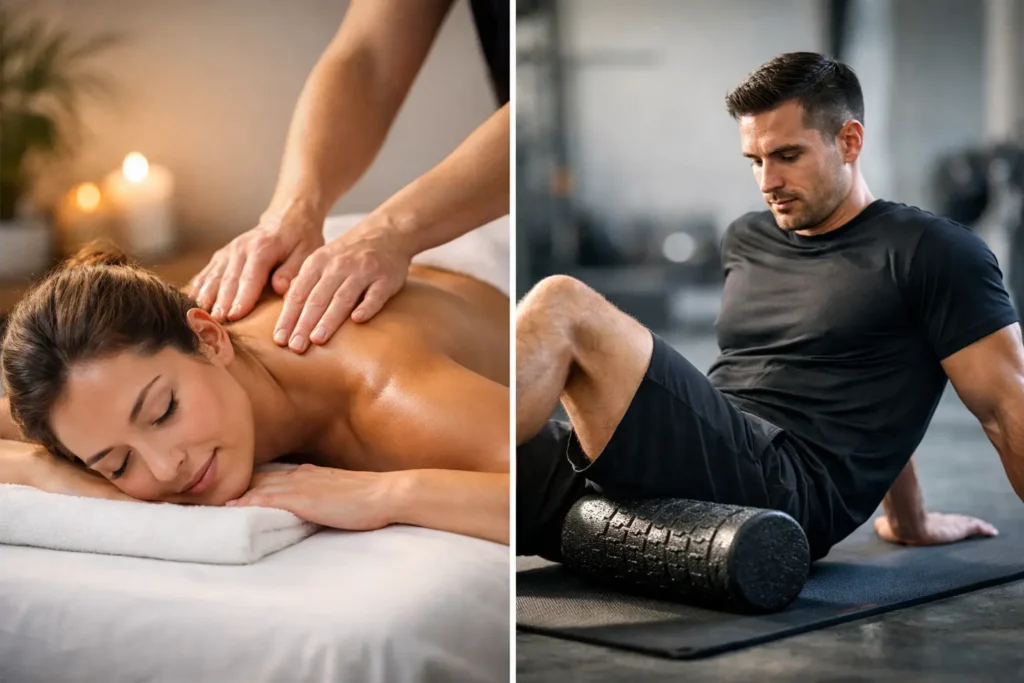
A foam roller can be useful after a long workday or a hard workout, but it cannot always reach the places that bother people most: the top of the shoulders, the base of the neck, the muscles around the shoulder blades, or a persistent spot in the low back. When considering massage versus foam rolling, the most helpful question is not which one is universally better. It is which approach fits your body, your tension pattern, and what you need that day.
Both can support short-term comfort, movement, and a sense of release from muscular tightness. They work differently, however. Foam rolling is self-directed and convenient. Therapeutic massage provides skilled hands-on assessment, adaptable pressure, and the ability to work with areas that are difficult or uncomfortable to address on your own.
Massage Versus Foam Rolling: The Key Difference
Foam rolling is a form of self-massage that uses your body weight against a cylinder or similar tool. You control the location, pressure, and duration. For broad muscle groups such as the calves, thighs, glutes, and upper back, a roller can be a practical part of a warm-up, cooldown, or brief movement break.
Massage is more responsive. A licensed massage therapist can feel differences in tissue tone, notice how one area may be contributing to another, and adjust technique as your body responds. A session may include therapeutic deep tissue work, trigger point techniques, shiatsu-informed bodywork, gentle mobility work, or other supportive approaches when appropriate. The goal is not simply to apply more pressure. It is to use the right pressure, in the right place, at a pace your body can tolerate.
That distinction matters when tightness is recurring. A roller may help you feel better temporarily in a broad area, while massage can provide a more individualized approach to a stubborn pattern involving the neck, shoulders, back, hips, or the effects of long hours at a desk.
What Foam Rolling Does Well
Foam rolling is accessible. It takes little setup, costs less than regular hands-on care, and gives you a way to respond when your body feels stiff between appointments. Many people find it especially useful for legs that feel heavy after walking, running, cycling, strength training, or a day spent standing.
A few slow passes can be enough. There is no prize for enduring intense discomfort. Rolling too aggressively can cause you to brace, hold your breath, or irritate an already sensitive area. Moderate, tolerable pressure paired with relaxed breathing is usually more useful than forcing a painful spot to “release.”
It also encourages body awareness. As you roll, you may notice one side feels more guarded, a hip moves differently, or a particular muscle group is consistently tender. Those observations can help you make better choices about movement, recovery, and when to seek professional support.
Foam rolling has limits. It is difficult to use precisely on the neck, chest, jaw, shoulders, and the muscles near the shoulder blades. It can also be awkward for people with wrist, shoulder, balance, or mobility limitations. Direct, forceful rolling over the low back is often uncomfortable and may not be the best choice, particularly when surrounding muscles are already sensitive.
Where Therapeutic Massage Has an Advantage
A therapeutic massage session is not a routine sequence applied to every body. Someone with desk-work shoulder tension may need careful attention around the upper back, chest, neck, and arms, while an active adult with recurring hip and back tightness may benefit from a different balance of focused work and calming nervous-system support.
Professional touch also allows for precision. A therapist can work around sensitive structures, use broad contact rather than a hard edge, and change angles without asking you to strain into an awkward position. Communication is part of the process. If pressure feels sharp, overwhelming, or simply unhelpful, it can be adjusted immediately.
Massage can be particularly valuable when your tightness seems connected to stress. Stress-related muscle tension often does not stay in one neat location. It may show up as elevated shoulders, shallow breathing, clenching, headaches associated with neck tension, or a back that never quite settles. In these situations, more force is not necessarily better. A thoughtful session can combine focused work with slower techniques that help the body shift out of constant guarding.
For clients at Senju Holistic Healing, sessions are tailored to comfort level, sensitivity, daily demands, and goals. Supporting techniques such as therapeutic cupping, craniosacral work, or gentle lymphatic methods may be considered when they fit the session, rather than treated as a one-size-fits-all formula.
When Foam Rolling May Be Enough
If you have general post-activity stiffness, no concerning symptoms, and can comfortably reach the area, a foam roller may be all you need that day. Think of it as a useful maintenance tool, not a test of pain tolerance.
Try rolling one area slowly for 30 to 60 seconds, then stand up and notice whether movement feels easier. A calf, glute, or upper-back area may respond well to a brief pass followed by a walk, light stretching, or a few comfortable mobility movements. If you feel more relaxed and can move with less resistance, there is no need to keep going.
A roller is also a good choice when consistency is the main challenge. Five calm minutes several times a week may be more helpful than one overly intense session that leaves you sore and reluctant to repeat it.
When Massage May Be the Better Choice
Consider therapeutic massage when a familiar knot keeps returning despite your usual stretching and rolling, or when the location is hard to address safely by yourself. Neck and shoulder tension, tightness between the shoulder blades, and complicated back discomfort are common examples.
Massage may also be the better fit when you cannot tell what your body needs. Many people alternate between avoiding a tender area entirely and pressing so hard that they feel worse afterward. Hands-on care offers feedback and a calmer setting to explore the pattern without guessing.
If discomfort affects sleep, work concentration, normal movement, or your ability to enjoy activity, it is reasonable to seek individualized support. Massage does not need to be reserved for a crisis. Regular sessions can be part of practical body care for people whose work, training, caregiving, or stress load repeatedly shows up as muscle tension.
A Better Approach Than Choosing Sides
For many people, massage and foam rolling work best together. Massage can address areas needing more specific attention and help you understand where your body is holding tension. Foam rolling can then support the work between sessions, especially for larger, easy-to-reach muscle groups.
Keep the home routine simple. A roller, a gentle ball against a wall, regular position changes during desk work, and comfortable walking or mobility can be enough. The best routine is one that leaves you feeling more at ease in your body, not bruised, exhausted, or pressured to perform elaborate recovery rituals.
Avoid foam rolling directly over joints, bony areas, numb regions, open skin, or an acute injury. If you have unexplained swelling, significant weakness, new numbness or tingling, severe pain, or symptoms that are worsening, seek guidance from an appropriate healthcare professional rather than trying to push through with self-massage.
Your body does not need the harshest tool to feel supported. Sometimes a few minutes with a roller is exactly right. Other times, skilled, individualized massage offers the care and attention that a piece of foam cannot provide. Paying attention to that difference is a steady way to build more comfortable movement over time.