
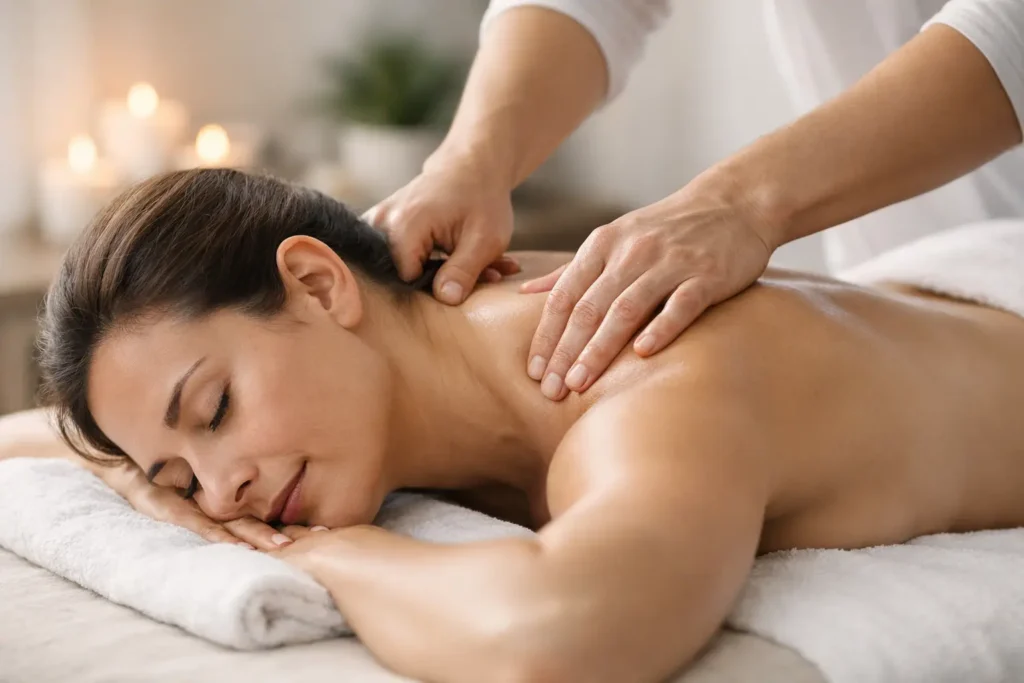
Stress often shows up before you fully register it. Your shoulders creep up toward your ears during work. Your jaw stays tight through the afternoon. Your lower back starts to feel dense and tired, even if you have not done anything especially physical. That is where massage for stress tightness can be genuinely helpful – not as a quick escape, but as practical bodywork that helps calm overworked muscles and reset patterns that keep returning.
Stress-related tightness is rarely limited to one spot. A person may come in saying their neck feels stiff, but the deeper pattern also involves the shoulders, upper back, ribcage, hips, or breathing habits. For some, long hours at a desk create a familiar pull across the chest and between the shoulder blades. For others, the body braces from daily pressure, hard training, poor sleep, or the mental load of caring for a family. The result is often the same: muscles that never fully let go.
Why stress tightness builds up in the body
When stress lingers, the body tends to hold itself in smaller, more guarded ways. Shoulders round forward. Breathing gets shallower. The neck works harder than it should. Muscles that are meant to assist posture and movement begin acting like they have to stay on duty all day.
This does not always feel dramatic. Sometimes it feels like heaviness, stiffness, recurring knots, headaches that seem to start at the base of the skull, or a back that feels tired by noon. Stress tightness can also make it harder to move freely, sleep comfortably, or recover from workouts and daily activity.
That is one reason a purely general massage may not be enough for some people. If the tension pattern has become familiar to your body, it often helps to have a session that pays close attention to where you are bracing, what feels restricted, and how much pressure your tissues actually respond to.
What massage for stress tightness should actually do
A helpful session should do more than press on sore areas. It should help the body shift from a guarded state toward a more settled one while also addressing specific muscular tension. That usually means working with both the obvious problem spots and the surrounding areas that contribute to them.
For example, neck tension may improve when attention is given not only to the neck, but also to the chest, shoulders, upper back, scalp, and jaw. Tightness in the lower back may respond better when the hips, glutes, and sides of the body are included. The goal is not to chase every sensation. It is to work thoughtfully enough that the body does not keep recreating the same strain right away.
At a therapeutic practice like Senju Holistic Healing, sessions are personalized rather than formulaic. Deep tissue massage may be useful for denser areas of chronic tightness, but deeper pressure is not always better. Trigger point work, shiatsu-informed bodywork, gentle mobilization, craniosacral work, or cupping may be blended in when appropriate. The value is in choosing the right approach for your tension pattern, not in forcing one method onto every body.
The most common areas stress affects
Neck and shoulders
This is the pattern many people notice first. Screen time, driving, work deadlines, and emotional stress can all create a feeling of constant lift and effort through the upper trapezius, levator scapulae, and the small muscles around the neck. The area may feel hard, achy, or tender to touch.
Therapeutic massage can help by reducing that sense of constant contraction and improving how the tissues glide and move. In many cases, slower, precise work is more effective than aggressive pressure.
Upper back and chest
Stress does not only tighten the back. It often shortens the front of the body as well. If the chest stays collapsed or guarded, the upper back has to work harder to hold you up. That can create the familiar combination of rounded shoulders, tight pecs, and aching between the shoulder blades.
Addressing both sides of that pattern often brings better results than working the back alone.
Jaw and scalp
People who clench their jaw or carry tension through the face may not realize how much it contributes to neck discomfort. Gentle, skilled work in these areas can be surprisingly helpful, especially when stress has become a whole-body holding pattern rather than a single knot.
Low back and hips
When stress combines with long sitting, the low back often starts doing too much. Hips stiffen, glutes become less responsive, and movement becomes less fluid. Massage may help ease this by reducing guarding and improving comfort in the surrounding tissues, which can make standing, walking, and bending feel less effortful.
What a personalized session may include
Massage for stress tightness works best when it is responsive. Some clients need focused deep tissue work in a few stubborn areas. Others do better with a steadier pace and moderate pressure that lets the nervous system settle while the body gradually unwinds.
A session may include trigger point work for recurring knots, shiatsu-informed pressure to address broader tension pathways, or gentle craniosacral techniques when the body is especially keyed up and sensitive. Therapeutic cupping may be appropriate for certain patterns of dense tightness and restricted tissue glide. In some cases, lymphatic or visceral techniques can support a greater sense of ease when the body feels congested, guarded, or hard to relax. These are not separate experiences so much as supporting tools within a treatment shaped around the person on the table.
That kind of flexibility matters. Stress tightness is not always just muscular. It can involve sensitivity, fatigue, shallow breathing, or the sense that your body is never fully at rest. A good therapeutic session respects that.
When massage helps most – and when it depends
Massage can be especially useful when stress shows up as recurring tension, limited mobility, muscular fatigue, and that familiar feeling of carrying too much in your body. Many people notice they can breathe more freely, turn their head more easily, or sit and stand with less effort after a well-targeted session.
Still, results vary. If tightness has built over months or years, one session may help, but it may not fully change the pattern. Bodies that have been bracing for a long time often respond better to consistent care, pacing, and realistic expectations. Sometimes the biggest early change is not dramatic relief but a quieter body, better sleep that night, or less reactivity in the usual trouble spots.
It also depends on pressure and timing. If you come in already overstimulated, exhausted, or sore from intense activity, overly aggressive work can leave you feeling more guarded. The best session is not the strongest one. It is the one your body can respond to well.
Getting more from massage for stress tightness
What you do after a session matters. You do not need an elaborate self-care routine, but a few simple habits can help the work hold longer. Slowing down for the rest of the day, drinking water normally, and avoiding the urge to jump straight back into strain can make a difference. Light movement, a short walk, or a few gentle posture resets often support the change better than doing nothing at all.
It also helps to notice your own patterns without judging them. If your shoulders rise every time you answer emails, or your jaw tightens during your commute, that awareness gives bodywork something to build on. Massage can reduce the physical burden of stress, but lasting comfort often comes from pairing hands-on care with small changes in how you hold yourself through the day.
Choosing the right kind of therapeutic massage
If your main concern is stress tightness, look for a massage therapist who listens carefully, works one-on-one, and adapts the session to your body rather than following a fixed routine. That matters even more if your tension is chronic, if you are sensitive to pressure, or if you have a mix of stress, posture strain, and recurring knots.
A calm private setting can also make a real difference. Many clients relax more fully when the environment is quiet and the work is focused, professional, and individualized. For adults in SW Portland and nearby areas who want practical help with neck, shoulder, and back tension, that kind of care often feels more useful than a generic relaxation session.
Stress may be part of life, but constant tightness does not have to become your body’s normal. Sometimes the most helpful step is simply giving your muscles a chance to stop working so hard, even for a little while, and letting skilled therapeutic touch remind your body what ease feels like again.